Case study · brand site
A quiz that sent
everyone to the same price.
AVAS is our sister agency, and its site had a diagnostic quiz on it. The quiz was the problem.
The problem
The site opened with a spin to win wheel. It got attention and qualified nobody.
The quiz that replaced it was worse in a quieter way. Nearly every combination of answers routed to the most expensive tier, and one outcome could not be reached at all no matter what you picked.
Worse still, the quiz threw the answers away at the exact moment someone converted. A visitor told it everything about their business and none of it reached the people who would call them back.
There was a layout defect nobody had named: the navigation ran to one width while the team grid was capped at another, so the roster sat visibly narrower than the bar above it.
What we built
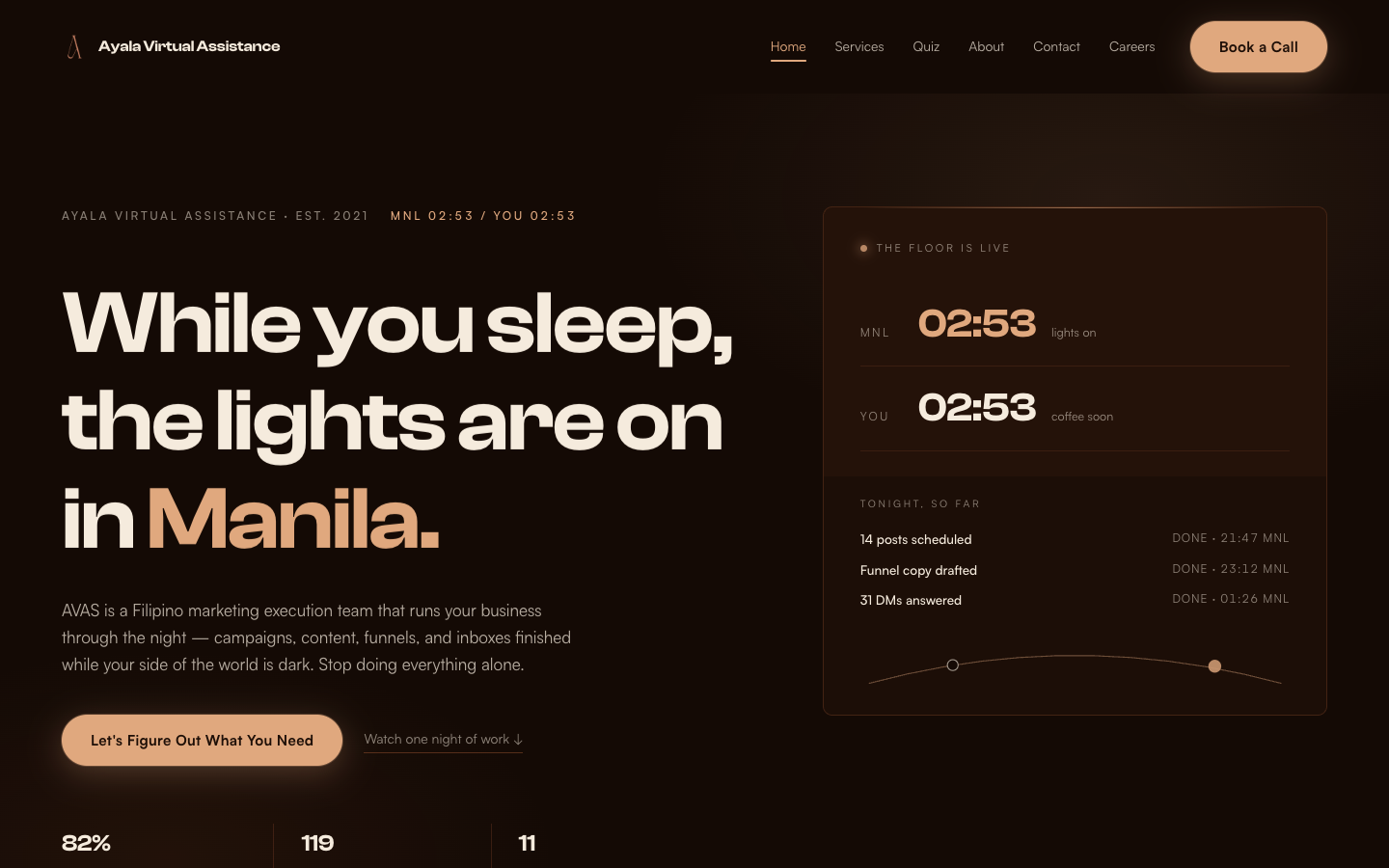
Six pages in a direction we called Night Shift: dark espresso, lamplight warmth, and a live pair of clocks showing Manila time beside the visitor’s own.
That clock pair is the page’s one structural idea, and it recurs through the site. It says the thing the copy is trying to say without saying it.
The quiz rebuilt from scratch, with the routing logic proven by enumerating every possible path through it rather than by spot checking a few.
A tier rule that protects the deal instead of maximising the quote: a solo founder cannot be routed to the enterprise tier no matter how urgent their answers are, because that quote would simply bounce.
Booking links that carry their own attribution, so a booking record says which page it came from.
What it does now
The site is live, six pages, verified page by page against the real domain.
Every quiz outcome is reachable, and the answers travel with the lead instead of being discarded.
The conversion path runs to a booking rather than a form, because that is how this business actually closes.
The same client runs an ops portal we also built. It sits on its own stack, separate from the site, and is in daily use by the team.
The trap worth knowing
The site’s stylesheet deliberately scopes everything under one class so the host platform’s styles can never collide with it. That decision has a cost nobody documents: any page level rule written the ordinary way loses to the reset and its spacing is silently dropped. No error, no warning, just margins that quietly do nothing. We found a page full of dead rules that had been written correctly and were losing anyway.
Your turn
We build the same way
for clients.
Real systems, shipped, with the same standards you just read. Thirty minutes, no pitch.